

Less than 48 hours after completing the wedding outfits for Taylor Swift and Travis Kelce, Jonathan Anderson appeared at Haute Couture Fashion Week Fall 2026 to present his second Haute Couture collection for Dior.
This widely watched wedding brought the fashion house an estimated media value of about $15 million during the US Independence Day holiday, according to data from Launchmetrics, and made Anderson the most talked about name of this year’s wedding season. Behind the scenes of the show, the designer called this an emotional project, and shared that working with Taylor Swift created a rare harmony. Once the runway started, however, the focus quickly turned to the dialogue between fashion and contemporary art.

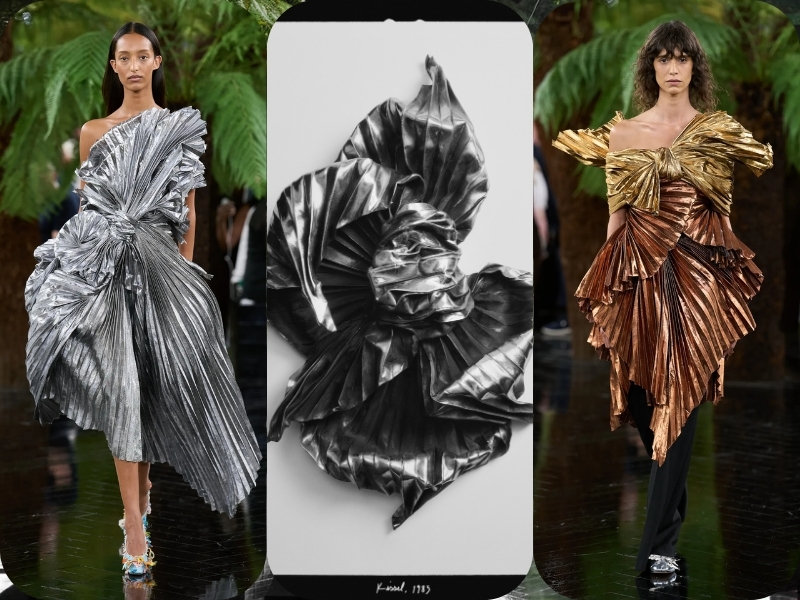
The creative fulcrum of the Fall-Winter 2026 Haute Couture collection is American female artist Lynda Benglis, who also collaborated with Dior to create a number of handbag models that appeared on the runway. This is not the first time Anderson has come to Benglis. Since his time leading Loewe, he invited her to design jewelry and included her metal sculptures in promotional campaigns and shows. That relationship continued to expand at Dior, but this time, instead of displaying the artwork alongside the clothes, Anderson translated Benglis’s visual language into the structure of the garments themselves.

Lynda Benglis is famous for exploiting materials that are not considered traditional in sculpture such as beeswax, latex, porcelain or paper fans. Anderson does not copy the form of the work but seeks to transform the spirit of experimentation into high-end tailoring techniques. “Goliath,” with its metallic pleats, was interpreted as a silver lamé dress shaped like a giant bow, while Benglis’s series of works made from foil-coated paper and steel mesh became the inspiration for skirts made of silver mesh, metallic panels and layers of overlapping chiffon.

The collection also opens a dialogue between Lynda Benglis and Christian Dior. Anderson refreshes the red Arizona trapeze jacket designed by the founder in 1948 with modern draping techniques, while exploiting the meeting point in both of their creative minds: love for nature. Dresses and coats with layered surfaces evoke wildflower meadows, where colors and textures blend together like patches of vegetation growing in the wild.

The Bar jacket, which has been a symbol of Dior since the “New Look” collection in 1947, continues to appear as a theme throughout. Anderson developed this symbol through many variations: a green tweed version with fringes stretching like ferns, or a speckled gray shirt that evoked television interference, then gradually melted into the white chiffon layer at the hem.

Trong nền âm thanh điện tử với nhịp điệu kéo dài, buổi trình diễn mang nhiều chất suy tưởng hơn là cảm xúc lãng mạn. Đây cũng là lời hồi đáp của Anderson trước những nhận xét cho rằng bộ sưu tập Haute Couture đầu tiên của ông tại Dior quá trung thành với hình tượng "người phụ nữ hoa" gắn liền với di sản Christian Dior. Thay vì lặp lại những biểu tượng quen thuộc, ông lựa chọn tiếp cận lịch sử của nhà mốt thông qua nghệ thuật, chất liệu và cấu trúc.

This collection also reflects the paradox that Dior is facing. On the one hand, Jonathan Anderson sees Haute Couture as a creative laboratory, that is, ideas are tested through dialogue with art history and material research. On the other hand, the brand is benefiting from the spread of a wedding that attracts global attention. Whether this experimentation will continue to appear in future wedding orders, or whether the commercial appeal of popular moments will gradually shape Dior’s direction, remains to be seen after Anderson’s second collection, a collection that placed faith in the possibilities of materials and ideas, rather than familiar romantic formulas.
Lesson: Hoang Bao – Fashion Columnist
