

Inside Musée Nissim de Camondo, Dior Men Spring Summer 2027 is placed in a space that carries historical memories. The collection opens as a way of rereading heritage, but not in the direction of reinterpreting the original. Instead, the references are pushed into a constant state of flux, with haute couture meeting rave culture.

At Dior Men this season, the concept of “archive” is more like an open material flow. Fashion memories are reconstructed through each new layer of interpretation, never collapsing into a single form. Inside the Musée Nissim de Camondo in Paris, a historic mansion known for its overlapping cultural memories, rich decorative arts collection and the typical spirit of contemplation of collectors, Jonathan Anderson introduced the Dior Men Spring/Summer 2027 Collection amid a large-scale restoration.

One year after his debut as creative director of Dior, the Irish designer has gradually shaped his aesthetic ideology for the fashion house: an approach based on the collision of eras, reference systems and romantic aesthetics. He brings designs as a process of “infection” and interference. Historical periods coexist, aesthetic codes intertwine, and classic patterns are disassembled and reconstructed in new orders.
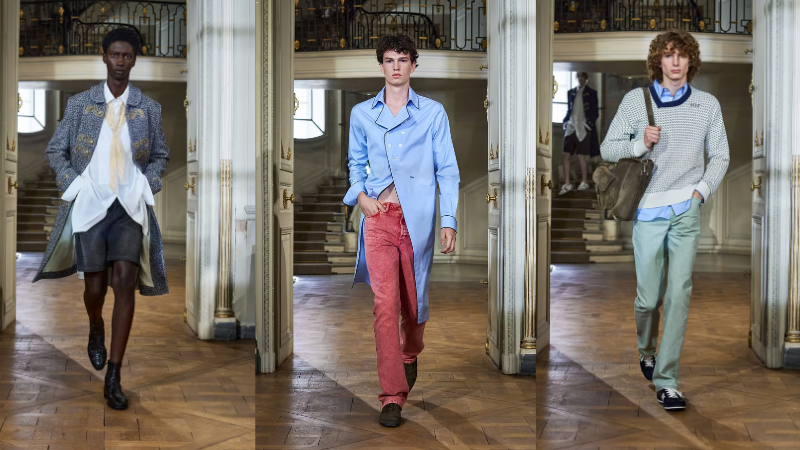
In a contemporary fashion context that often strongly exploits reference elements as a decoding game, Anderson puts reference itself at the center of the experience. The collection thus resembles a continuous process of recognition, a form of visual quest. Thanks to this, each design contains a hidden layer of quotation, a deviation or a subtle shift in the collective memory of the image.
On the runway, clearly structured shapes like relaxed tuxedos, navy plissé suits or generously proportioned double-breasted jackets form the foundation of the collection, but they only serve as starting points for a language that is constantly expanding and redefining itself.
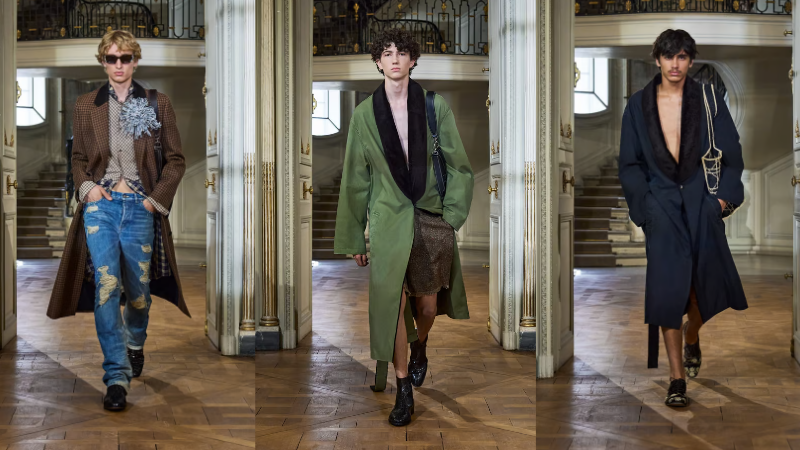
Throughout the performance, every form seemed to be constantly being disassembled and then restructured in a state of constant change. One jacket that seems to have a classic spirit suddenly opens up with see-through panels of silk chiffon, while another coat design recalls the structure of the historical riding coat (redingote) but features details borrowed from Napoleonic military uniforms. In a further layer of memory, the iconic Bar jacket from Christian Dior’s 1947 “New Look” returns in deconstructed form, now reconstructed from tweed bearing traces of use, other times bent in such proportions that the original is almost unrecognizable. The overall feeling is like witnessing Dior’s memories being continuously tampered with, disassembled and reconstituted in a never-ending cycle.

This transformative spirit becomes more evident in the jacket and blazer designs with elongated and lowered lapels, developed from a sketch by Marc Bohan rediscovered in the fashion house’s archives. Here, craftsmanship reaches a level of sophistication in the way materials are handled. The polka dots are no longer woven but are created using intricate sequin embroidery, while shirts use a trompe l’œil effect inspired by a 1979 Dior Haute Couture scarf. Even the classic pied-de-poule has been converted to print rather than woven, further subverting expectations of how an aesthetic code should be created and functioned.
Parallel to the almost absolute precision of technique is a more instinctive and liberal flow of energy. Jonathan Anderson has mentioned the influence of contemporary rave culture and the music of Fred Again, an undercurrent of inspiration that runs throughout the entire project. This is not 1990s rave culture in its original form, but a generational evolution that retains the need for escape, connection and liberation, but expressed in the language of the present.
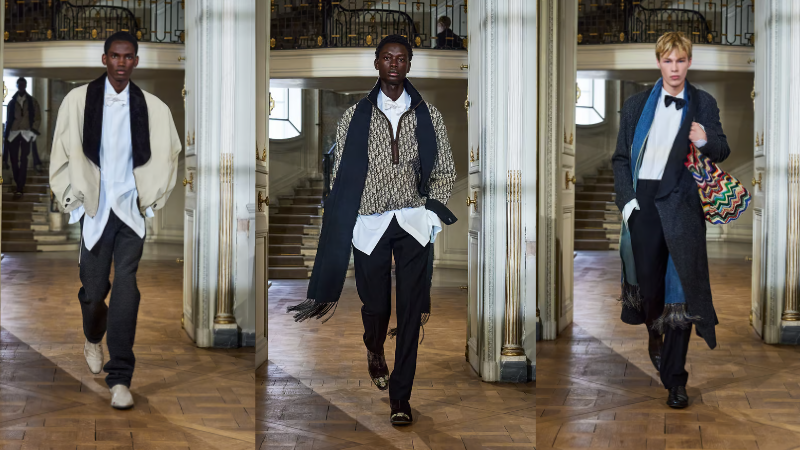
That same impulse Anderson translated onto the runway through jeans covered in sequins, metallic knits with a used feel, torn and redecorated denim, and boots that caught and reflected light with every movement. Here, the energy of the night and the discipline of the couture atelier coexist in the same wardrobe.
Surprise becomes the principle of creating a collection. It appears in the seemingly smallest details: the tassels on the edge of a cardigan, the see-through of a double-breasted blazer, the unexpected sequins appearing on pants, or the clever simplification of a sweater placed among a series of structurally and technically rich designs. Instead of being loyal to a fixed aesthetic system, Jonathan Anderson chooses ambiguity as a fulcrum, with a constantly shifting perspective and layers of reference constantly overlapping each other.
Accompanying the show is a series of oil paintings by contemporary artist Giangiacomo Rossetti, in which models are recreated in portrait-like compositions, wearing typical designs from the collection. At the intersection of painting and fashion, the image becomes another interpretation of the same aesthetic system that is constantly redefining itself.
Lesson: Hoang Bao – Fashion Columnist
