

Tại Galleria Nazionale d'Arte Moderna e Contemporanea ở Rome, Fendi giới thiệu bộ sưu tập Haute Couture Thu Đông 2026, đồng thời đánh dấu màn ra mắt của Maria Grazia Chiuri trên cương vị Giám đốc Sáng tạo của nhà mốt. Buổi trình diễn diễn ra dưới bầu trời mùa hè của Rome, tại một trong những bảo tàng mà Chiuri yêu thích, cũng trùng thời điểm nơi đây khai mạc phiên bản tái hiện triển lãm về Fendi do Karl Lagerfeld thực hiện vào năm 1985.

Instead of starting with the form, Maria Grazia Chiuri chose to tell Fendi’s story through materials. According to her, the identity of the fashion house is formed from fur crafting. Therefore, materials are always the starting point and shapes are developed around the characteristics of each surface. If many Haute Couture fashion houses build designs by shaping the shape first and then finding suitable materials, Fendi goes in the opposite direction: listen to the materials before deciding on the cut. This mindset became the foundation for the entire collection.

The result is a study in intarsia, lace and hand-embroidered techniques perfected within the collection, in the hands of the Fendi workshops. Intarsia is a technique of joining many pieces of different colored or different materials onto the same surface to create a seamless pattern, requiring very high precision because each piece must be cut and assembled by hand. Rather than using this technique as a form of decoration, Chiuri sees it as a means to tell a story about structure and materials.

The designs in the collection are all aimed at the feeling of enveloping the body instead of tightening the lines. This approach recalls the revolution that Karl Lagerfeld and the five Fendi sisters, including Paola, Alda, Carla, Franca and Anna, initiated in the 1960s and 1970s, when they removed the heavy structure of traditional fur coats to create lighter and more flexible designs.

That spirit is clearly expressed through a silk georgette dress combined with black and white leather strips, a material that has been associated with Fendi since the early days. In order for the pattern to always be in the correct position on the wearer’s body, each piece of leather must be calculated and adjusted according to each customer’s individual measurements.

Another design that attracts attention is a trench coat that combines many materials, made from two-layer cashmere but does not use lining to keep the weight at a lightest level. Based on this material, the artist continues to graft fur and leather using the intarsia technique, creating a surface rich in depth while still maintaining the softness of the fabric. Pleats appearing throughout the collection give shapes a sculptural dimension, while also creating jackets and coats with almost negligible weight. The robes alone also remind of the Pope’s outfit, an image associated with the history and cultural life of Rome.

Chiuri also exploited the kimono as a starting point to develop coats for both men and women. From the structure of traditional Japanese clothing, she combined Western tailoring details to continue developing the idea of a unisex wardrobe, which appeared in the previous ready-to-wear collection. Designs in velvet, grain de poudre and silk linings show how Fendi blends tailoring with the softness of Haute Couture. Panne velvet material was also renewed on suits with a more flexible structure, while tulle became the support frame for gown models.

Costume surfaces continue to expand the dialogue with art history. The Art Deco-inspired arabesque motifs appearing on the dress remind of the two schools of Bauhaus and Vienna Secession. These are the sources of inspiration that deeply influenced Karl Lagerfeld during his time leading Fendi. One of the most striking designs is a floor-length coat assembled entirely from pieces of fur and leather left over from the production process, arranged into a floral pattern. Not only does it demonstrate the skills of the Haute Couture workshop, this design also shows the coordination between many different craft departments within the same fashion house.
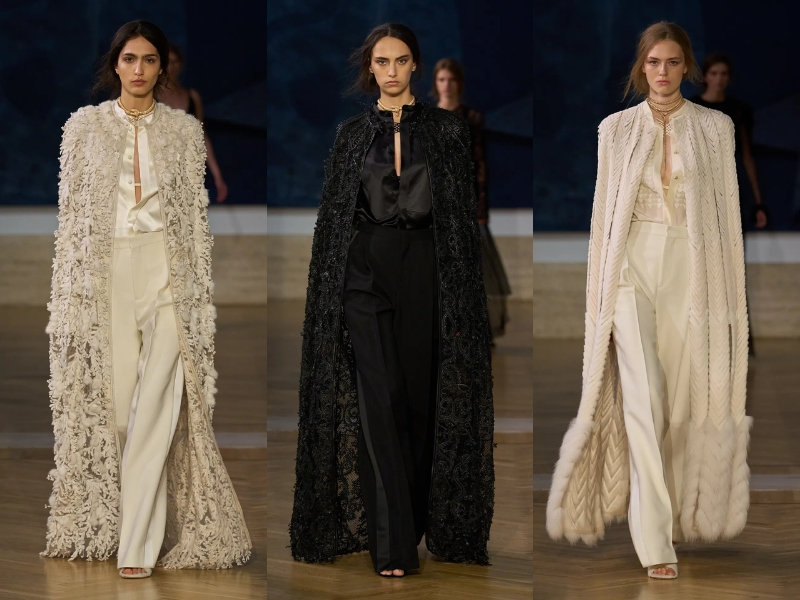
The collection’s color palette revolves around black and parchment. According to Chiuri, this shade is reminiscent of the suitcases and leather accessories of Fendi’s early days, and appeared in the Cruise 2027 collection. A 1970s-inspired parchment-colored suit also appeared as a tribute to Karl Lagerfeld, who always admired Marlene Dietrich as well as the five Fendi sisters, women who ran the family business with independent thinking in a time when that was still rare.

The designer also shared that her time working with the brand’s founders left a profound influence on her creative thinking. At that time, the design process was not governed by the pace of the collection launch schedule but was guided by experimentation. It is the combination of seemingly unrelated materials that opens up many new possibilities. For Chiuri, that spirit is part of Fendi’s identity and is also what connects the fashion house to the city of Rome.
Lesson: Hoang Bao – Fashion Columnist
